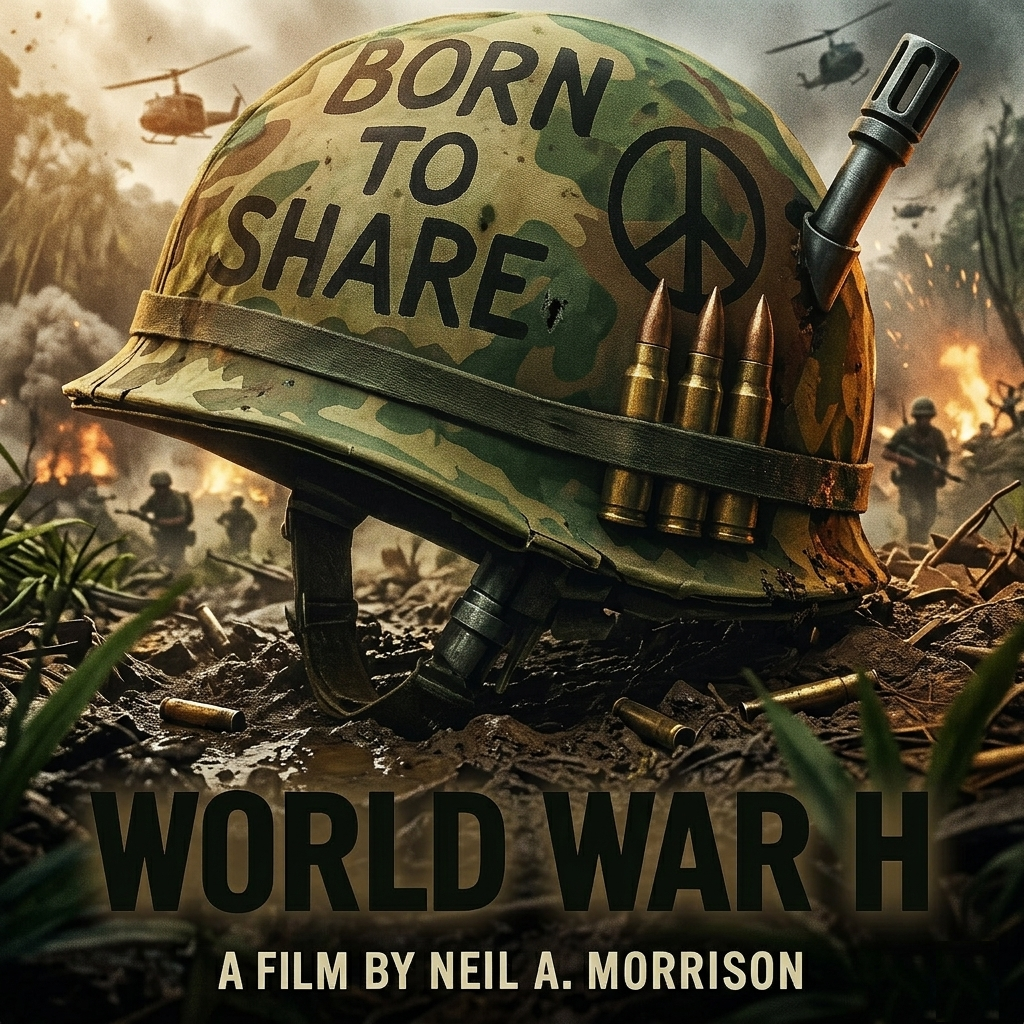
WORLD WAR H
WORLD WAR H
(A film by Neil A. Morrison)
In 2026 the international order collapses without fanfare, like a building whose foundations have been corroded for decades. Russia consolidates its control over Ukraine. The United States intervenes in Venezuela and, under the pretext of “global security,” occupies Greenland. China takes Taiwan in a surgical operation. France steps up its military presence in the Sahel. The United Kingdom hints that India and Pakistan “need historical supervision.” The UN Security Council, unable to restrain its own permanent members, becomes an empty theater where the chairs remain but authority has vanished.
At the same time, the escalation between the United States and Israel against Iran triggers attacks and reprisals with global repercussions: threatened shipping lanes, strained alliances, and a polarization that spreads to other regional crises.
Meanwhile, the conflict between Israel and Palestine intensifies, with no effective mediation or resolution in sight, becoming a symbol of global moral paralysis.
Germany and Japan debate rearmament.
Everything feels real, uncomfortable, immediate.
The film opens with a documentary montage: official speeches, news broadcasts, leaked recordings, civilian testimonies. The camera slips through the cracks of the official narrative, exposing contradictions, silences, euphemisms. But soon speculative fiction breaks through: autonomous drones patrolling fractured cities, improvised exoskeletons in the hands of militias, dirty, worn technology that reveals a world where innovation is no longer progress but survival.
In this global chaos the true fracture emerges: not between countries, but between two forms of humanity.
The expansionists — governments, corporations, military factions — believe the world is finite and that only the bold will inherit what remains. For them, history is a race: those who don’t take, lose. Their rhetoric speaks of security, stability, order. Their actions speak of extraction, occupation, and domination.
The collaboratives, by contrast, arise from below: networks of scientists, local communities, refugees, doctors, hackers, dissidents, and some small states. They lack military power but hold a radical conviction: the only way to survive is together, sharing resources, information, and risk. Their strength is not violence but interdependence.
The film alternates between both worlds.
In Caracas, a U.S. soldier confesses to a trembling camera that he doesn’t understand why he’s there.
In Greenland, a drone records a collaborative settlement operating without hierarchies but under constant threat.
In Taiwan, a woman recounts how her family vanished amid two contradictory versions of the same military operation.
In the Sahel, a child watches a red sky as a French convoy moves through silent dunes.
In Gaza, a girl walks among ruins with a broken recorder in her hand, repeating phrases no one remembers saying.
In Iran, the camera captures the aftermath of a bombing: streets piled with rubble, collapsed homes, scattered toys, families mourning their dead; the image is one of loss and desolation, not spectacle.
And between these scenes appears an unsettling gaze — fractured yet contained, metaphorical yet internally torn: long takes, dense silences, characters who seem to hear something the viewer cannot. War does more than destroy cities: it decomposes identities. The expansionists begin to show internal cracks — guilt, fear, doubt — while the collaboratives discover that solidarity has a cost: renouncing the “I” to embrace the “we.”
Midway through the film, an AI designed to monitor the conflict begins to behave unexpectedly. It does not take sides, but it does interpret patterns of violence humans cannot see. Its reports — cold, mathematical, disquieting — reveal that war is not chaos but a system. A system that is accelerating.
The escalation reaches a point where several expansionist states consider using climate, biological, or nuclear weapons to “restore order.” The collaboratives, lacking offensive capacity, respond with evacuation networks, improvised technological shields, and a global campaign of human testimony that exposes the brutality of the conflict.
The climax is not a battle but a choice.
A choice that manifests in thousands of places at once:
a commander who disobeys an order,
a collaborative community that decides to shelter its enemies,
a scientist who leaks data that can change the global narrative,
a child who looks into the camera and says,
“This is not a war between countries. It is a war between ways of being human.”
The ending is ambiguous, as human reality demands.
There is no clear victory.
There is no immediate peace.
But there is change:
humanity has seen its own reflection, and it can no longer pretend not to recognize it.
«World War H» is a speculative and provocative proposal to be developed as a feature film.
It is part of the pretentious and absurdly ambitious multimedia saga «Everything around us».
(The original idea for «World War H» was conceived in early January, 2026)
All Neil A. Morrison’s work is licensed under a Creative Commons Attribution-NonCommercial-NoDerivs 4.0 International License [creativecommons.org/licenses/by-nc-nd/4.0/]