THE GREENLAND CORRIDOR
THE GREENLAND CORRIDOR
(A film by Neil A. Morrison)
In January 2026, an anomalous winter opens Arctic sea routes weeks ahead of schedule. In Washington, the President of the United States — a man obsessed with the idea that Greenland is “surrounded by Russian and Chinese ships” — interprets the thaw as a strategic signal. He orders the acceleration of Greenland Corridor, a classified operation meant to turn the island into a permanent military passage under U.S. operational control, even if formally integrated into NATO. To him, Greenland is not a territory; it is a shield, and a shield cannot have an owner.
In Copenhagen, the Danish government receives the news wrapped in technical jargon and promises of cooperation. But beneath the diplomatic surface lies an old fear: losing real sovereignty over Greenland. In the midst of this tension, Lykke Sørensen, a data analyst of Danish-Greenlandic origin, detects anomalies in satellite records: interference repeating with unsettling precision, unidentified drones, patterns that seem to respond to something more than an algorithm. What first appears to be a technical glitch begins to take the shape of a message, or an echo.
Sent to the forward base at Kangerlaq, a semi-buried installation in the permafrost, Lykke meets Commander Cole Harrington, a U.S. officer acting under direct presidential orders. The base has an uncanny atmosphere: too much silence in the corridors, vibrations that don’t match the machinery, screens showing images no one remembers capturing. Civilian scientists detect sudden sinkholes and geometric fractures in the ice, as if the terrain were reacting to an invisible pressure. Dr. Elias Mørk speaks of “resonances” that shouldn’t exist, of cavities that return impossible echoes.
As Lykke digs deeper, she discovers that the anomalies are not enemy signals but “simulations generated from Washington” to justify the expansion of the Greenland Corridor. But she also uncovers something more disturbing: some signals do not come from the system, nor from any known human actor. They are patterns that appear only when she observes them, as if the territory — or something beneath it — were responding to her presence. The ice stops being a mere backdrop and becomes a silent interlocutor, an organism that seems to warn, imitate, or remember.
When Lykke tries to alert Copenhagen, she discovers that part of the Danish government already knew about the operation and has chosen to look the other way to avoid an open conflict with the United States. Caught between loyalty to her country, NATO pressure, and a presidential paranoia threatening to consume Greenland, Lykke realizes that the real battle is not military but narrative: who defines the threat, who controls the territory, and who decides what is real in an Arctic melting faster than the political certainties meant to contain it.
Deep within the ice, in a cavity where sound behaves impossibly, Lykke hears a white echo that belongs to no machine. It is not supernatural. It is not science fiction. It is the land looking back. And in that gaze, the boundary between data and vision, between geopolitics and perception, between system and landscape, begins to dissolve.
«The Greenland Corridor» is a speculative and liminal proposal to be developed as a feature film.
It is part of the pretentious and absurdly ambitious multimedia saga «Everything around us».
Note: But I’m a bit short on funding and I’m afraid that a very smart lady is going to beat me to it.
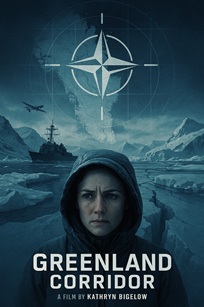
(The original idea for «The Greenland Corridor» was conceived in early January, 2026)
All Neil A. Morrison’s work is licensed under a Creative Commons Attribution-NonCommercial-NoDerivs 4.0 International License [creativecommons.org/licenses/by-nc-nd/4.0/]